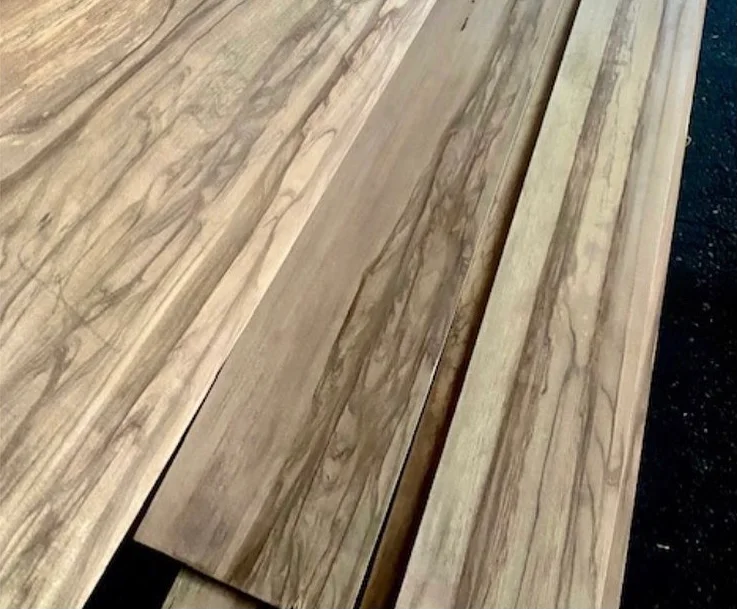
Ask what the sample represents
A timber sample can help you choose a surface, but its small size can hide the decisions that will matter across a whole cabinet or dining table. Start by asking exactly what you are holding: the species, the product construction, the finish and whether the sample represents the material currently available for your project.
A colour name on its own is an incomplete specification. “Warm oak” might describe a visual effect without explaining the timber, coating or construction. Write the answers on the back of the sample so that a later comparison does not depend on memory.
Keep samples from different suppliers separate until their specifications are clear. Two pieces that look similar in afternoon light may be very different products to repair or maintain.
Look at variation across several pieces
WoodSolutions’ interior-design guide explains that timber varies in colour and figure, and that selection works within agreed ranges rather than producing an exact colour match. Ask to see several pieces or a larger installation made with the proposed material.
For veneer, the arrangement of adjacent leaves changes the appearance. Book matching creates mirrored pairs, while slip matching repeats leaves alongside one another. These patterns can look quite different over a run of cupboard doors even when a small sample looks much the same.
Discuss where joins, grain direction and changes in colour will fall. Ask whether the supplier can show a drawing or photograph of the proposed arrangement. A sample should help establish an acceptable range, not imply that every part of a natural material will be identical.
Turn the sample over and inspect the edge
Ask how the finished object will be built and what happens at corners, openings and exposed edges. If the face is veneer, what is beneath it and how are the edges finished? If the piece is solid timber, how does the maker intend to assemble it? These are questions for the actual product, not judgments that one construction method is always superior.
The V&A’s furniture-making guide is a useful introduction to how joints and fabrication shape an object. It encourages looking beyond the decorative surface to the work that holds a piece together.
For a cabinet, request an edge or corner sample as well as a flat face. For a table, ask to see the underside and the way the top meets the base. Those views often clarify more than another polished front photograph.
Compare the finished surface in the room
View the sample beside the materials it will meet, under daylight and your usual evening lighting. Change its orientation: a vertical cupboard door and a horizontal tabletop catch light differently. Confirm that the sample has the same finish proposed for the order.
Ask for written cleaning and maintenance instructions, including what can realistically be repaired if the surface is damaged. Our guide to repairing furniture before replacing it is a useful companion to that discussion.
Finally, separate appearance from sourcing. A beautiful grain does not establish provenance. Our explanation of FSC labels on timber and furniture looks at another part of the buying decision. Keep the material specification, finish and sourcing information together with the approved sample.