Start with the parts
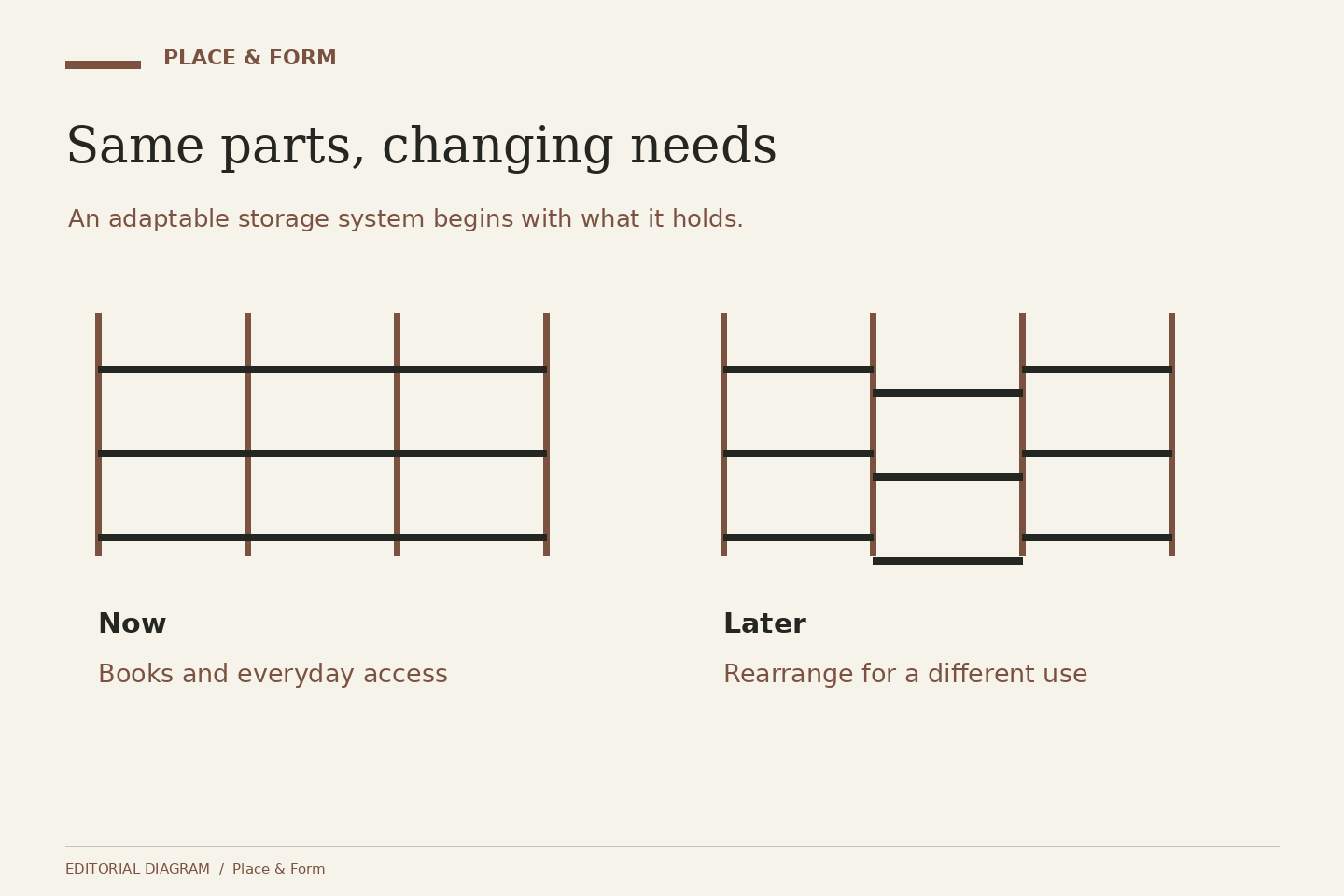
Designed by Dieter Rams in 1960, Vitsœ’s 606 Universal Shelving System uses aluminium E-Tracks and components hung from pins. Shelves, cabinets and tables can be arranged within the system, with planning support offered by the manufacturer. Its interest lies in the relationship between a durable kit of parts and a room whose demands will change.
A shelf is often bought as a finished composition. A system asks a different question: which parts are needed now, and which might remain useful when the contents or address change?
Inventory before composition
Begin with what the shelving must hold. Books, records, files, ceramics and electronic equipment have different depths, weights and access needs. Measure the awkward objects rather than averaging everything into an attractive grid.
Then identify what should remain open and what should disappear behind a door. Visual calm does not necessarily require fewer possessions; it may require a clearer division between display, daily access and storage. Draw an ordinary working day through the proposed arrangement. The shelf used every morning should not be the one that is hardest to reach.
Flexibility has conditions
The ability to add or rearrange components is valuable only when the system suits the building and the way you use it. Vitsœ offers different structural configurations, so the wall, ceiling and room conditions need to inform the specification. Use the manufacturer’s planning and installation advice for support, loading and fixing decisions.
For a renter, the relevant questions may concern permission to fix into walls and what happens at the next move. For a long-term home, they may concern a future desk, changing book storage or a room taking on another purpose. ‘Modular’ is a starting point for those questions, not an answer to all of them.
Leave some capacity unused
A completely filled wall can look resolved in a drawing and leave no room for ordinary change. Consider leaving a bay, shelf position or section of wall available for a later need. Price the useful first arrangement and a plausible future addition separately.
The appeal of 606 is clearest when the initial installation is treated as one moment in a longer use. Buy the configuration that works now, understand how it can change and retain the planning information. That makes adaptability a practical quality rather than a design slogan.